Friday, February 15, 2013

NOTHING LASTS FOREVER (Part 2 - Wait...But I Thought...WHAT HAPPENED?

Die Hard With a Vengence (DH3) came out in 1995.  Movies had changed somewhat since DH2 in 1990 and a lot since DH in 1988.  There was a dwindling level of emotional content in action movies taking place in the 1990s.  Maybe it was audience impatience.  Maybe studios just figured what audiences really wanted was a little less conversation, a little more action.  Whatever the reason for this changing aesthetic, DH3 fit in perfectly with it.


Now, there's a lot about DH3 worth liking (more on that below).  Another terrorist - a mad bomber this time - is blowing up buildings and throwing NY into chaos.  For some strange reason, he talks in puzzles and demands that one man be brought in to be a part of the drama, John McClane.  The department is happy about this because John can be a bundle of trouble.  But to stop the killing of innocent citizens, they haul him in.  And this is the one of the first looks we get at John McClane in this latest installment.


He's back in NY (no longer LAPD), beaten down, hungover, angry and - for reasons only agents and business affairs executives will ever really know - once again estranged from Holly.  This represents the film's first major lapse in judgement.  Though it makes perfect sense that Holly shouldn't be given the exact same story function she held in the first two movies (heck she needn't be in the film at all for that matter), but to deny her essential importance to John's character arc through two entire films, explaining away their separation as a the result of marriage doomed to failure due to John's character flaws was a cynical and lazy choice.  He overcame those character flaws and won her back.  We saw it happen.  So why were they trying to tell us now that he's incapable of change?  In choosing this path for McClane, the filmmakers consciously decided to step back from the originality of the character and redirect him to be a generic James Bond knock-off.  From this decision on, his job was to save the world, not just stop a crime that endangered a group of innocents that happened to include someone he cared about deeply.  Again, I'm not insisting that Holly had to be a part of this story, but she didn't need to be thrown to the lions either.  In fact, the wasted opportunity here is for John to be the one in danger for a change.  To know that someone out there cares for you and needs you around is a strong motivation for survival.  This is especially true for first responders, like, say, cops.

So starting with the original premise: A mad bomber is terrorizing New York City.  His one big demand is that John McClane be forced to play a role in whatever effort is made to stop it.  The feds are involved now and McClane's being hauled in against his will anyway, so why not haul him in from LA to join the NYPD for a special investigation?  Maybe he's grown to like the sunshine of Los Angeles.  Maybe he's starting to wonder why he didn't come here sooner?  He and Holly and the kids have a nice house.  Al Powell is an easygoing partner.  Life ain't so bad.  Then the feds come and tell him they need him to come back to hellish, congested Manhattan in the middle of an August heatwave to stop a madman.  He's driven by duty, because he's that kind of guy.  Holly knows it, so she sends him off with a kiss and a dire warning that he better come back in one piece.  And, now, John McClane, who loves his wife and hates to fly, has to leave her behind and board a plane for JFK - unsure of why this murderous lunatic is demanding his attention.   Had they opened that way, well, then now I still feel like I'm in the world of Die Hard.

Once he's in NY, we could still have all the things that work well about the film as it stands: Seeing McClane on the streets of NY, the serious and unglamorous team of cops led by Larry Bryggman's weary but reliable Inspector Cobb.  Fellow cops Joe Lambert (Graham Greene) and Connie Kowalski (Colleen Camp) and the others can (and should) still be in the fold, talking smack about playing their badge numbers in the lottery and busting each others' chops like they do.  (These are the people McClane came up with.  They're not impressed with his adventure at Nakatomi or Dulles.  Imagine the fun they'd have at Hollywood McClane's expense.)

The guys don't mess around.
Putting John McClane back in NY was actually one of the things this film did right.  It gave the series the grit and sweat of a great, old, big-city cop movie.  It gives us a glimpse into the NY cop in his element for a change.  But it would have worked better to have him dragged back there.  That way,  when we find out later that the bomber is actually the vengeful brother of Hans Gruber, who has a personal vendetta against John McClane's, his return would make good thematic sense.  His past is thrust at him in ways he thought they never would be if he had any say in the matter.  He's forced to face what he left behind in more ways than one.

Now the action can begin with a nice foundation of emotional backstory.  Now we have a reason to get on his side other than wanting to hear the solutions to the puzzles thrown his way.  And above all, no mater what happens, we want him to accomplish two things beyond stopping the bomber. 1) Make peace with his old NYPD chums and 2) Get safely back to Holly where he belongs.  The added bonus to all this is that you haven't blown up the bridge to Die Hard 1 & 2, in fact, you've built  a new one.

And much of what is great about Die Hard is at work in DH3.  I enjoyed the addition of new sidekick, Zeus, played by Samuel L. Jackson.


Manhattan on foot in the sweltering heat was a great arena for testing McClane's physical limits.  The public schools being threatened, the subway cars at risk of being blown to pieces, the taxi chase through Central Park - all of this was fresh territory for the series.  But the one scene that stands out, in my estimation, that really feels like a microcosm of how the math of a Die Hard movie works, is the scene on the elevator in the Federal bank.

McClane is escorted by a bad guy dressed in and NYPD uniform and he recognizes the badge number of this imposter as that of a fallen fellow officer.  How does he remember a detail like the badge number?  Because he just had the conversation about playing badge numbers in the lottery earlier in the film.  McClane knows he's in the presence of a villain, but the villain doesn't know he knows.  It's a brilliant reversal of the Hans Gruber/Bill Clay scene from DH1.  McClane plays it cool until he sees an opening that allows him to take down everyone in the elevator.  It's that kind of detective-work moment that made us love McClane in the first two films because it allowed us to think, "Yeah, if I were him, I would've remembered that, too."

However, if the first major misstep of DH3 is the handling of Holly, the second is the gradual elimination of McClane's vulnerability.  By the end, he survives a hundred foot drop onto the deck of a ship and goes on fighting for one-and-a-quarter acts.  In DH 1 & 2, when McClane got beat up, he needed time to recover.  That ended up being valuable time for us to get inside his soul as he assessed what really mattered to him in this crazy world.  He wasn't allowed that here.  Instead, he bounces back from his and falls like he's made of steel.  When that happens, he started to drift away from being the guy we knew, the new kind of action hero that took us by surprise, and he became a much more conventional, and less interesting superhero.  AND becausee they never set up a still strong and meaningful relationship with John and Holly, the ending where he calls her to make amends (again!) just rings hollow.  They cheated themselves out of a stronger, more emotionally-satisfying ending in which he could have re-earned the respect of his old NYPD partners and headed back to L.A. wiser man who is still grateful he survived to see her another day.

UP NEXT: LIVE FREE (OF ANY NOTICEABLE RELATIONSHIP TO) DIE HARD


Thursday, February 14, 2013

NOTHING LASTS FOREVER (Part 1 - Our Love Will Never Die Hard)

A Good Day to Die Hard (or as I'll refer to it from here on, Die Hard 5, or DH5) opens today and is sure to have monster-size opening weekend attendance.  I mean, of course... Who doesn't want to see a good John McClane movie again?  You remember good-old John McClane!  He was the NY cop from the seminal 1988 action film Die Hard who was a breath of fresh air because he wasn't like any other movie NY cop we'd ever seen!

"Come out to the coast. We'll get together. Have a few laughs."
Here's a guy who's afraid of flying, hates L.A., his wife has a skyrocketing career and he isn't used to that idea yet.  But he's been working on it and now all he wants is to go to LA for Christmas to see if he can somehow show her.  And maybe he can even convince her to move back to NY and restore their family under one roof.  The love's still there, after all, it's just...complicated.  So, how hard can it really be to fix?  Of course, then he screws up and slips back into old patterns, doesn't he?  Damn.  But at least he reprimands himself for it.  He is still trying.  But he's  imperfect, vulnerable, only human.  Then, AW, MAN! Terrorists lock down the building!  He didn't come to LA to save the world, he just came to save his marriage.   Now he can't do that unless he keeps these robbers from killing his wife.  This problem is above his pay grade, so he tries to report it and stay alive long enough for the cavalry to arrive and handle it.  He'll only step in if it becomes necessary and he'll only take the minimum action required to get from A to B.      

Man, I love that guy!  And audiences love that guy!  You know why?  Because, dammit, we're all imperfect and trying to be better, too.  We all want to avoid trouble so we can focus on getting or keeping our lives happy and worry-free.  When faced with trouble, we all want it resolved with a minimum of effort, too.   He's just like us in that way.  So, yeah, if they want to tell more stories about this guy, then Yippie-ki-ay.  Let's do it.

BUT...if the hard-to-avoid reviews are accurate, then John McClane isn't in this DH5.  Oh, sure, Bruce Willis is using the name John McClane.  But apparently he's using it to represent a chaos-seeking, indestructible robot.  By all accounts so far, the guy we know, love and identify with is nowhere to be found in the smear of car wrecks, explosions and shattered glass.     

(FULL DISCLOSURE: I haven't seen DH5 yet, but I do want to.  Or, more to the point, the nostalgic, masochistic boy in me wants to.  But not having seen it doesn't disqualify me from talking about the McClane character's replacement with a genetically identical, but inexplicably soulless copy.  I saw that happening in Live Free For Die Hard - henceforth, Die Hard 4 or DH4.  In fact, the first shades of his transformation were already visible in Die Hard With a Vengance or DH3.)

When DIE HARD hit theaters, it was the culmination of lessons learned well over nearly a century of moviemaking.  It was based on a book nobody had read, "Nothing Lasts Forever" by Roderick Thorp.  There was an attempt to make the film many years earlier with Frank Sinatra as the lead, but it never panned out.  Over the years, they retooled the character, gave him a wife instead of an adult daughter, and went in a new direction.  When it finally got a release date in 1988, Bruce Willis was best known for his turn as snarky-romantic P.I., David Addison, in TVs "Moonlighting." It was hard to imagine what kind of action star he'd be.  The pre-release posters featured the building.  No face.  They eventually released this version:  


We all felt it.  Hollywood was afraid they would scare us off with a mere TV star, so they were easing into the idea, using their tools carefully to manufacture a movie star.  What none of us who sat down in theaters realized until the film started rolling is that they didn't have to work too hard to make that happen.  Willis exuded relatable, everyman charm - the key component to making John McClane who he needed to be.  The movie itself crackled.  Director John McTiernan had found the precise balance between character, action, space, time, truth, spectacle, tension, humor, immediacy and resonance that movies must strive for to stand the test of time.  It was The Taking of Pelham 1-2-3 meets The Towering Inferno.  It was an event.  You just knew there would be sequels.

The key to the Die Hard, in the end, was not the stunts or gunfire or swinging or running or jumping or the exploding helicopters - those elements were all just fun, necessary pieces of activity.  The foundation upon which Die Hard was built on how important it was for John McClane to be good enough to deserve his marriage to Holly Gennaro.

"As long as you love me so...Let it Snow, Let it Snow, Let it Snow."
Bruce Willis and Bonnie Bedelia were a couple so believable, so ordinary and inconspicuous, that they became us, our parents, our grandparents.  They argued like us and, when they worked out what was coming between them, they made up like us.  In the end, it was those two against the world.  And the world just wouldn't leave them alone.  When John realized he was wrong, when he thought he was going to die and asked his new best friend, Al Powell (Reginald Veljohnson), to tell Holly he was sorry, he became the man she knew he could be.  From that moment on, their marriage was healed for the rest of their days.  He'd been through hell putting things right and he wasn't going to lose her twice.


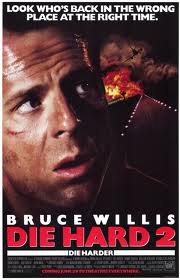
This essential truth is what makes the film's follow-up, Die Hard 2: Die Harder, arguably its most successful sequel.  (It's also the thing nearly all the imitators missed when they started pitching their "Die Hard in a [Insert Location Here]" ideas.  It was never about the lockdown.  It was always about who was locked down.) In DH2, they found a new sandbox in which to play - Dulles Airport in Washington DC - and a new way to keep Holly in on the action - when the airport is taken over by paramilitary terrorists, she's on one of the planes that can't land.  As time ticks on and her plane's fuel runs low, John is once again determined to get her back in one piece.  Saving the lives of hundreds of other passengers is a close second.  Stopping the terrorists remains the merely incidental activity that needs to happen to accomplish goals one and two.

Now, the action and dialogue were not as elegant as the DH1 (outside of one of the most efficient recap/exposition scenes in modern movies to open things up - he moved to LA, despite not liking it, he did it for Holly and he still cares about what her parents think of him as a husband - all good stuff).  And maybe director Renny Harlin didn't move with the grace and confidence that McTiernan did.  There was a somewhat silly-by-today's-standards anti-technology motif, for example.  (I excuse it, in the end because it became a key part of the film's climax.)  The villain (played by William Sadler) is less unique.  (Hard to top Alan Rickman's Hans Gruber.)  But at its core, DH2 was far truer to its characters than anything that came after.  Because it knew what the central conflict was in the world of Die Hard movies, it was able to recapture the magic to some degree.

"Why does this keep happening to us?"
Not only that, they did a clever job of substituting characters from the first film. Al Powell makes an appearance, but his sidekick role is taken over by airport employee Leslie Barnes (Art Evans).  Airport Police Capt. Carmine Lorenzo (Dennis Franz) provides as formidable (and comical) an obstacle to McClane as Deputy Police Chief Dwayne T. Robinson (Paul Gleason).  Also William Atherton's Richard Thornburg is a welcome return.  These are the players that make a Die Hard movie.  (Of course, they can't all be in every film, but this one managed it.  Maybe some future episode will bring back Thornburg or Powell, for old times' sake.)  That fact that consideration was given to all these roles helped make DH2 feel like its predecessor.  In a way it was like the feeling you get when you cook one of your mother's old recipes.  You didn't get it just right, but it takes you right back.

And again, the fact that John McClane takes a serious beating in his quest for his share of domestic bliss, allowed us to identify.  It allowed us to say, "Yeah, I'd go through that for the person I love.  If I really had to."

So, what happened next?  Well, after going through hell TWICE to keep his marriage intact, John McClane would be faced with his greatest challenge yet...how to do it again.

We all agree another terrorist mastermind taking Holly hostage in a contained space wouldn't really work. "We gave it to you once," we'd have said, "But this time you gotta do something new." That was the bridge between the first two films, but to go there again would be a bridge too far.  So what did the keepers of the Die Hard franchise do?  They blew up the bridge.


UP NEXT: WHAT'S WRONG WTH THIS PICTURE?


Tuesday, December 11, 2012

THE GRAY CUBICLE

This is my cubicle. She is gray.


Every surface, just...gray. I spend my days in her cold, lifeless arms, though I would never say I'm "wrapped up" or "hugged" or "huddled" or "cuddled" or anything so warm and wonderful. She's not affectionate like that. This is the first time I've really examined her all up-close and personal. In the photo above she's actually kind of pretty. There's a glow about her, a silvery shine, no? Don't be fooled. This is a flattering portrait that masks her power to wear down the human spirit. She's a vampire, a predator who was here before I was and will be here when I'm gone, just sitting, waiting for the next me to come along. Like a shark, she consumes indiscriminately, dispassionately. It's not personal, what she does. It's not her fault. It's just her nature. In a way, I pity her.

But that doesn't mean I like her. So today, I took her photograph. Today I make my first real attempt to slip out from under her influence while remaining in her presence. Today I take a look at her and simply tell the truth about her, nothing more. That's quite enough for today. Any more and she might notice. Because, you see, when the cubicles took over the war for mens' souls, the did so a step at a time - quietly, non-threateningly - until one day, they were in charge. Like their revolution, mine will begin with a small, unnoticeable action. Then another and another. In time, she'll wonder just where the heck I went.

- OO